In concrete block production, the cheapest machine on paper is not always the most economical machine over time. Concrete block machine lifecycle cost is shaped by much more than the purchase invoice. Over the years, the real cost is built through electricity use, maintenance work, spare parts, uptime, operator support, and the ability to keep production stable as requirements change.
Why Concrete Block Machine Lifecycle Cost Matters More Than Purchase Price
For producers, this matters because cost pressure continues long after commissioning. Downtime, slow changeovers, difficult maintenance, and weak upgrade flexibility can all make a machine far more expensive than it first appeared. CPI has noted that no equipment is designed to run without maintenance and that good housekeeping is essential to keeping maintenance costs under control. CPI also highlights that energy efficiency in block production should be considered across the entire life cycle of the equipment, not just at the moment of purchase. (CPI Worldwide)
A cost-effective block machine is not simply the one with the lowest upfront price. It is the one that gives the producer the best long-term balance between output, reliability, quality, energy use, maintenance simplicity, and future flexibility.
This is where Mecmetal’s machine concept takes a different approach. Servo motor technology is a way to replace complex hydraulic systems with more precise movement control, lower lifecycle costs, and reliable performance in demanding factory conditions. In practical terms, that means the machine architecture is designed not only for production output, but for lower upkeep burden over time.
Long Life Cycle Starts with Machine Architecture
A long machine life is not an accident. It starts with the design principle.
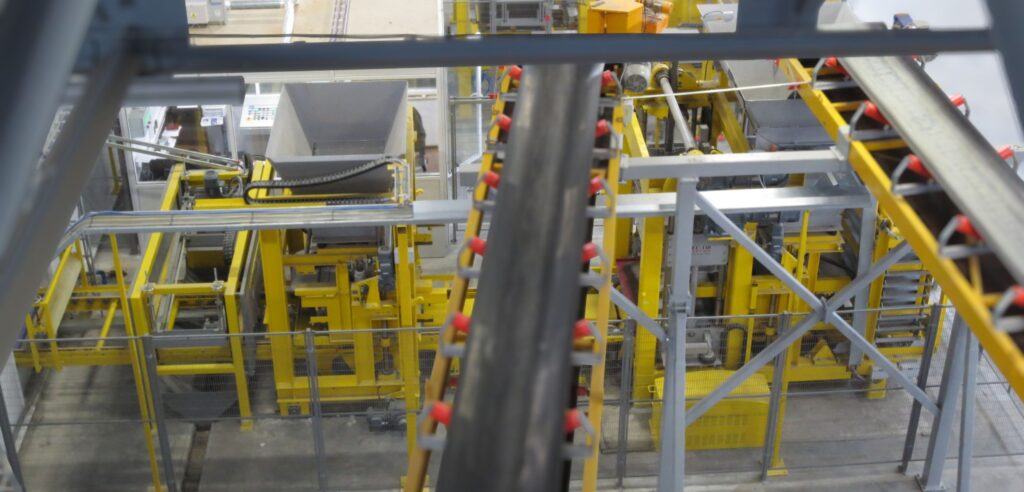
Mecmetal company manufactures premium electric concrete block machines, customer-specific production lines, and life cycle services. The company also helps producer’s lower lifecycle costs, improve production efficiency, and achieve consistent high-quality production. On the product side, Mecmetal MEC Evolution-20 is the world’s only fully electromechanical servo concrete block machine and it is a cleaner and more efficient alternative to hydraulic systems.
That machine concept matters because wear, adjustment precision, and maintenance complexity are all influenced by the operating architecture. Mecmetal’s MEC Block Machines have an average lifespan of 25 years, are built with high-quality materials and components, and benefit from low wear and tear due to servo motor capabilities and precise movement adjustments. After choosing Mecmetal as a supplier, MEC block machine owners have multiplied their return of investment with higher than average production uptime and lower operational costs. (Energy-efficient concrete block machine)
Lower Wear and Simpler Maintenance Reduce Lifecycle Cost
One of the biggest hidden cost drivers in block production is not the major breakdown. It is the constant burden of wear, recurring maintenance work, and the time consumed by upkeep that could have been reduced by a different machine concept.
MEC Block Machine has low wear and tear thanks to servo motor capabilities and precise movement adjustments, and that wear parts are designed to be easy to replace. Emphasize that there are no investment or upkeep costs related to hydraulic lines, hydraulic parts, or a hydraulic unit. That is a meaningful economic point, because removing hydraulic complexity means removing a full layer of future maintenance burden. (Hydraulic vs Electric)
Mecmetal maintenance service highlight advance planning, fast availability of spare parts, professional mechanics and automation technician, and service agreements are designed to keep production running at the highest capacity. That means lifecycle cost is not only reduced by hardware design, but also by the company and service model around the machine.
Easy Replacement of Wear Parts Matters More Than It Sounds
Ease of replacement is often treated as a minor feature until the plant has to stop for a change.
In reality, the economics are simple: if wear parts are difficult to access, slow to replace, or tied to overly complex mechanical systems, maintenance cycles are extended and become more expensive every time the issue repeats. In MEC block machines, with the knowledge and feedback for over 30 years in industry, the wear parts are engineered to be easy to replace, and the broader machine concept is built around lower wear and simpler upkeep. (Smart maintenance)
The same engineering logic can also be seen in Mecmetal’s mold approach. In MEC Molds wearable mold parts are changeable so the mold can be reused multiple times as long as the main frame remains healthy, and that in average use its molds run 60,000 – 100,000 production pallet cycles before wear-part changes are needed. That design philosophy directly supports lower total upkeep cost over time.
Integration Flexibility Protects Future Investments
A machine investment should not become a dead end.
Production requirements change. Product catalogs expand. New handling, packaging, diagnostics, or surface-treatment solutions may need to be added years after the original installation. That is why integration flexibility is a real lifecycle-cost issue.
The servo control system and software enable integration-ready interfaces for additional equipment, alongside other features such as digital twin, predictive maintenance, real-time remote service, and cloud backup. The Paver Block Machine page reinforces the same point from a practical angle: while some AC motors may remain for practical reasons, everything operates within the same servo control system. Additional features such as face mix functionality and additional software can be included from the manufacturing stage, making that route more cost-effective than retrofitting later, and that additional surface-treatment equipment can be added to create more product variety.
This is where long-term value often becomes clearer. A machine, production line and software that can grow with the factory, adapt to new products, and integrate external or additional equipment more cleanly is often more economical over five or fifteen years than a machine that looked cheaper at the point of purchase but becomes costly every time the plant evolves.
Long Life Cycle Also Means Commercial Usefulness
A long machine life has real value only if the machine stays commercially useful.
That means the machine must keep delivering not just years of operation, but years of reliable output, stable product quality, and practical serviceability. Advantages of MEC block machines are precise movement, stepless adjustments, high utilization rate, short downtimes, easy maintenance, and accurate real-time diagnostics. The SCADA is smart, versatile, and user-friendly, with the ability to help production managers and operators make recipe changes, test aggregates, and develop new products more successfully and more quickly.
This matters because long service life without useful adaptability is not enough. A producer needs the machine to remain relevant when products change, raw materials change, quality expectations rise, or labor becomes harder to find.
The key difference between “durability” and “lifecycle value.” Durability means the machine survives. Lifecycle value means the machine remains useful and relevant to production economics over many years.
Lower Lifecycle Cost Helps the Producer’s Customers Too
The economic benefits of lower lifecycle cost do not stay inside the factory.
When the machine is easier to maintain, more predictable to operate, and flexible enough for future upgrades, the producer gains:
- fewer interruptions
- lower surprise costs
- better planning stability
- and more consistent output
That stability matters directly to the producer’s own customers. Builders, distributors, landscapers, and homeowners do not care how a machine is powered. They care whether products are available, consistent, and delivered when promised. If lifecycle cost is under control, delivery reliability becomes easier to protect, quality stays more stable, and stock can be managed with less financial stress.
In that sense, concrete block machine lifecycle cost is not just a plant issue. It is part of customer trust.
Conclusion
The real cost of a block machine or production line is not decided on the day the supply agreement is signed. It is decided over years of operation.
Concrete block machine lifecycle cost is shaped by:
- Machine architecture
- Wear and tear
- Energy consumption
- Maintenance and labor burden
- Ease of part replacement
- Diagnostics and service support
- Ability to integrate new functions and add-ons
Mecmetal supports a clear long-term value: fully electromechanical block machines and production equipment, lower wear, easier replacement of spare parts, no hydraulic-related problems and upkeep, integration-ready controls for future add-ons, and a published average lifespan of 25 years for MEC Block Machines, supported by broader production-line equipment of more than 30 years average service life. (mecmetal.fi) (mecmetal.fi)
For the producer, this means faster return of investment time, lower total cost of ownership, stronger long-term flexibility and high production capacity.
For the producer’s customer, it means more predictable deliveries, more consistent quality, and greater confidence in the products they buy.
Investing in new production equipment?
If you want to discuss how Mecmetal’s fully electric machine architecture, maintenance simplicity, and integration-ready control philosophy could fix your current production pain points and support your production goal over the long term, get in touch with our team below.
Remember to read the rest of the series.
Part 1: Energy-Efficient Concrete Block Machine
Part 2: Smart Maintenance and Diagnostics
Part 3: You are reading this part
Part 4: Consistent Product Quality
Part 5: Fault-tolerant desing