Concrete block machine reliability is easy to take for granted when everything is running normally. Its real value becomes visible when production schedules are full, factory conditions are demanding, and even a short interruption can affect the rest of the week.
An unexpected machine stop is rarely just a maintenance problem. It can interrupt the whole production line, change production priorities, reduce available yard stock, create overtime, and put delivery schedules under pressure. For builders and landscapers, the technical reason behind the stoppage usually does not matter. What matters is whether the required products are available when promised.
What makes a concrete block machine reliable?
A reliable concrete block machine combines robust mechanical construction, accurately controlled movements, systematic lubrication, protected automation components, real-time diagnostics, secure backups, and service support. Reliability is not created by one component alone, but by designing the entire machine and support system to reduce failures, identify abnormalities quickly, and recover efficiently when something unexpected happens.
For Mecmetal, this is the core behind a high operational rate and fault-tolerant machine concept.
What Concrete Block Machine Reliability Really Means
No industrial machine operates forever without service, wear, adjustments, or occasional faults.
A more useful way to think about reliability is to ask:
How much productive time can the machine deliver, how predictable are the planned interruptions, and how quickly can the operator identify and recover from unexpected problems?
This distinction matters. Planned maintenance, mold changes, cleaning, and product changes are normal parts of production. Unplanned downtime is different because it immediately disrupts the production plan.
Modern condition-monitoring systems follow the same principle. Siemens describes condition monitoring and predictive maintenance as ways to use machine and process data to identify abnormal behavior, improve reliability, reduce downtime, and make better maintenance decisions. SEW-EURODRIVE similarly describes continuous condition monitoring as a way to create transparency around drive condition and plan service work proactively instead of waiting for unexpected failures.
The goal, therefore, is not an unrealistic promise of zero faults.
The goal is fewer surprises and better control when something changes.
Harsh Factory Conditions Test Operational Reliability
A concrete block plant is not a clean laboratory.
Dust, vibration, repetitive mechanical movements, changing temperatures, long production shifts, and hard materials create demanding conditions for both mechanical and electrical systems. Equipment intended for this environment needs to be designed accordingly.
MEC Evolution-20 concrete block machine combine robust mechanical construction with electromechanical servo-driven operation. Service life exceeding +30 years. Mecmetal connects the block machine and production-line components to real-time data collection and monitoring systems, giving operators immediate feedback about production and machine operation.
Environmental protection matters especially for automation hardware. Mecmetal specifies dust-proof electrical cabinets with integrated cooling systems as part of its reliability concept. This follows established industrial automation principles: ABB notes that reducing dust exposure and controlling cabinet heat load improves the reliability of industrial drive systems in harsh environments.
It may sound like a small detail compared with cycle times or production capacity, but electronics usually perform better when their operating environment is controlled. Protecting automation equipment from dust and unnecessary heat is therefore part of protecting production uptime.
Real-Time Data Turns Machine Behavior Into Useful Information
A machine can tell a lot about its condition before it actually stops, but only if the information is available and understandable.
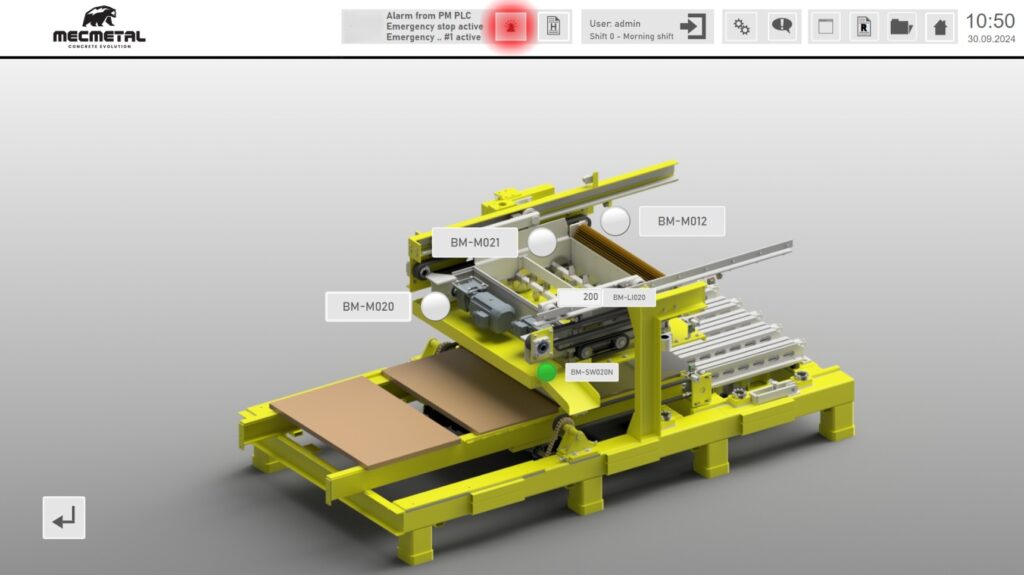
MEC Block Machines collect real-time information from servo motors and field devices. The control system uses this information for production monitoring, diagnostics, maintenance support, and operator feedback. The company also offers MEC Pro Factory, which brings factory information from batching plant to entire production facility together into a centralized digital view covering production, maintenance, HSE, historical data, error reporting, and resource monitoring.
This changes troubleshooting from:
“Something is wrong. Where do we start?”
toward:
“Something changed here. This shows suggestions for what caused this. Let’s go there to find out why.”
That difference can be important.
Real-time data does not magically prevent every breakdown. Its value is that changes in machine behavior can become visible earlier, giving operators and maintenance personnel better information for deciding if they should act on this now, at the end of the shift or send a troubleshoot to Mecmetal specialist for immediate analysis via 24/7 service.
The same principle is used throughout modern industrial automation. SEW-EURODRIVE’s condition-monitoring systems continuously evaluate operating data to detect changes in areas such as vibration, temperature, bearings, and gearing, while Siemens describes industrial monitoring systems that use real-time information and anomaly detection to support predictive maintenance and stable production.
Servo Control Supports Both Precision and Mechanical Reliability
Mecmetal’s electromechanical architecture is important not only for energy efficiency and product quality. It also affects the way mechanical movements are executed.
In a MEC Block Machine, critical repetitive movements are controlled by servo motors. Movement speed, position, and operating profiles can be adjusted precisely instead of relying on uncontrolled mechanical impacts or fixed movement characteristics. Mecmetal links these servo capabilities to lower wear and tear, precise movement adjustment, operational reliability, and fewer unwanted production stoppages.
This is one reason why the different themes in this article series are connected.
Energy efficiency, consistent product quality, maintenance simplicity, and operational reliability are not four completely separate machine benefits. They are partly consequences of the same underlying machine architecture.
When movements are controlled accurately, the machine can perform the required production task without unnecessary mechanical stress. Over thousands and millions of repeated movements, that matters.
Automatic Lubrication Removes One Everyday Risk
Lubrication is another example of something that appears simple but has a major influence on long-term mechanical reliability.
MEC Block Machines include an automatic central lubrication system, reducing the dependence on operators remembering individual lubrication points manually.
The engineering logic behind automatic lubrication is well established. SKF explains that automatic systems deliver controlled amounts of lubricant to moving components at defined intervals, helping reduce friction and wear while lowering the risk of inconsistent manual lubrication. SKF also specifically promotes automatic lubrication in cement and aggregate environments as a way to improve reliability and reduce downtime.
For a concrete producer, the practical value is straightforward.
The fewer important maintenance actions that depend solely on someone remembering them before a busy production shift, the more predictable the maintenance process becomes.
Automatic lubrication does not remove maintenance. It makes one important part of maintenance more systematic.
Fast Mold Changes Reduce Planned Downtime
High operational availability is not only about avoiding breakdowns. Planned interruptions also affect overall plant efficiency.
Product changes, mold changes, cleaning, setup, and routine service all consume production time. Some of that time is unavoidable, but the machine can still be designed to reduce it.
Mecmetal includes automatic express mold-changing features in its operational reliability package. The wider control and recipe system also allows production settings to be stored and reused for different products immediately.
This matters particularly in factories producing many different products.
A plant that produces only one block type for weeks at a time has different requirements from a producer switching between paving stones, masonry blocks, face-mix products, insulated blocks, and special products.
When product changes are frequent, reducing changeover complexity becomes part of maintaining a high operational rate.
Automatic Backups Make Recovery Part of Fault-Tolerant Design
Prevention is one side of fault tolerance.
Recovery is the other.
Mecmetal’s control-system concept includes automatic backup of programs, parameters, and recipes. This may be one of the less visible advantages of the machine, but it becomes extremely valuable when it is needed.
Production recipes and machine parameters represent accumulated factory knowledge. They can contain years of adjustment work for different molds, raw materials, products, and production conditions. Losing that information after a hardware problem or control-system failure can create much more work than simply replacing the failed component.
A proper backup strategy therefore protects more than software.
It protects production knowledge.
If a damaged automation component can be replaced and the required software, parameters, and recipes restored efficiently, recovery becomes much more controlled than rebuilding production settings from memory.
Diagnostics Should Help the Operator, Not Overwhelm Them
Collecting large amounts of data has little value if the people operating the plant cannot use it.
That is why diagnostics should not only exist for automation engineers. Information also needs to guide the operator toward the problem.
Mecmetal’s current machine concept includes real-time diagnostics, predictive maintenance options, production reporting, and control-system feedback intended to support operators during production. Remote diagnostic and lifecycle services are also part of Mecmetal’s after-sales offering.
This is important because troubleshooting time often depends on how quickly the problem can be narrowed down.
There is a big difference between an alarm that effectively says:
“Machine stopped.”
and information that helps determine:
which movement, sensor, drive, or condition caused the sequence to stop and why.
The better the information available to the operator and service team, the less time needs to be spent searching blindly.
Remote Support Turns Diagnostic Data Into Action
Good diagnostics become even more useful when the same information can be accessed by people outside the factory.
Mecmetal offers remote diagnostics and lifecycle services alongside its equipment, and its digital architecture includes real-time remote service capabilities. MEC Pro Factory further extends this by providing cloud-based visibility into factory operation and maintenance information.
For an international producer, this can reduce the importance of physical distance when diagnosing an automation problem.
Not every issue can be solved remotely. Mechanical failures still require hands, tools, and spare parts at the machine. But remote access can help determine what has happened, what should be checked, and which parts or expertise may actually be needed before someone travels to the factory.
That can turn:
“Send someone here and we’ll find out what is wrong.”
into:
“We know what we need to inspect. Let’s solve it.”
Fault-Tolerant Concrete Block Machine Design Is Built in Layers
- No single feature makes an industrial machine fault-tolerant.
- The strength comes from multiple layers working together:
- Robust mechanics help withstand repetitive production.
- Servo-controlled movements help reduce unnecessary mechanical stress.
- Automatic lubrication supports consistent maintenance.
- Protected and cooled electrical cabinets help automation components operate in demanding conditions for decades.
- Real-time data makes abnormal behavior easier to identify.
- Diagnostics help narrow down the cause.
- Backups protect software, machine parameters, and recipes.
- Remote support connects factory personnel with additional expertise when needed.
None of these features individually guarantee uninterrupted production. Together, however, they make the production system more resilient, more understandable, and easier to recover.
That is the more useful definition of fault tolerance in a concrete block factory.
High Operational Rate Ultimately Becomes a Business Advantage
The reason producers around the world care about machine availability is not because uptime itself but the final product; paving stones, landscaping products, or masonry products available for customers when they need them.
When production is reliable, the producer can plan more confidently. Yard stock does not need to compensate as heavily for unpredictable output. Maintenance resources can be scheduled more intelligently. Customer orders are easier to promise. Employees spend less time firefighting and more time improving production.
And the producer’s customer benefits without ever needing to understand the technology behind it.
- The builder gets the blocks.
- The landscaper gets the paving stones.
- The retailer keeps stock available.
- The project stays on schedule.
That is ultimately what high operational reliability is supposed to achieve.
Conclusion
Concrete block machine reliability is not created by claiming that a machine will never fail.
It is created by designing the machine and the surrounding support system so that failures are less likely, changes are easier to detect, maintenance is more systematic, critical information is protected, and recovery is faster when something unexpected happens.
Mecmetal’s approach combines robust electromechanical construction, precise servo control, real-time production data, automatic lubrication, protected electrical cabinets, automatic backups, intelligent diagnostics, and lifecycle support.
Want to Make Production Reliability More Predictable?
Mecmetal can help evaluate how machine architecture, servo technology, diagnostics, preventive maintenance, digital tools, and lifecycle support could improve the reliability of your production as a complete system.
Contact our team and let’s evaluate where your production risks are today and how they could be reduced.
Find your local Mecmetal person
If you want to explore the other sides of the same machine concept, continue with the previous parts of the series
Part 1: Energy-Efficient Concrete Block Machine
Part 2: Smart Maintenance and Diagnostics
Part 3: Concrete Block Machine Lifecycle Cost
Part 4: Consistent Product Quality
Part 5: You are reading this part.