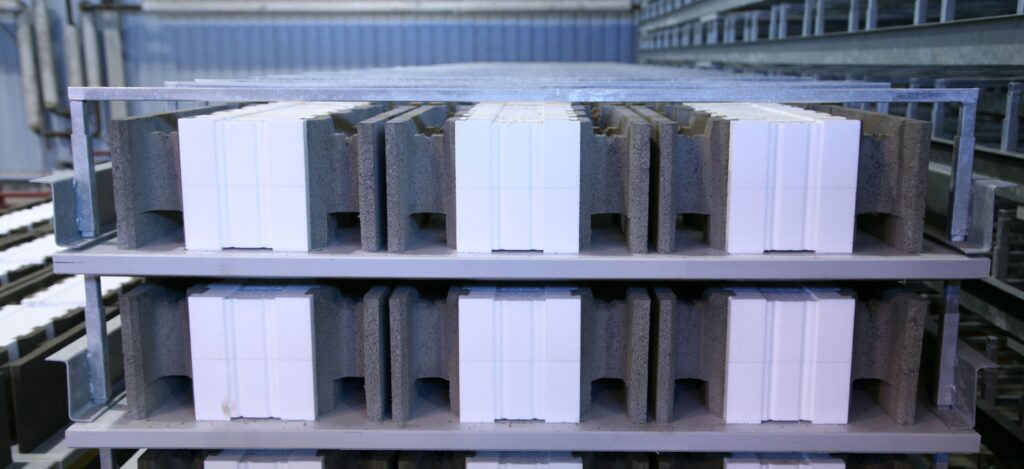
In concrete block & paving stone production, quality is not only judged by standards inside the factory. It is judged at the customer’s site.
If block height varies too much, if paving stone surfaces become inconsistent, or if products do not install the way the buyer expects, the result is not just a technical imperfection. It becomes waste, rejects, slower installation and customer complaints. That is why consistent product quality is not only a manufacturing goal. It is a commercial requirement.
But everything starts inside the factory.
Why Consistent Product Quality Matters More Than Ever in Concrete Block Production
Consistent product quality in concrete block production is not only a manufacturing goal. It is a commercial requirement. If block height varies too much, if paving stone surfaces become inconsistent, or if products do not install the way the buyer expects, the result becomes waste, rejects, slower installation, and customer complaints.
This challenge is getting harder, not easier. BFT notes that in concrete block and paving block production, fluctuations in raw materials, changes in the concrete mix, wear on tools, and altered machine settings all have visible and measurable effects on product quality. At the same time, market expectations keep rising, while labor shortages increase the pressure for better automation and reproducibility.
Product Quality Is a System Result, Not a Single Machine Feature
A good concrete product is never created by one variable alone.
Strength depends heavily on recipe, raw materials, curing, and overall process control. Dimensional accuracy is also influenced a lot by mold quality. But while molds and mix design matter, the concrete block machine still plays a central role in whether quality stays stable from cycle to cycle. That is because repeatability in filling, tamping, compaction, and vibration is what turns a good recipe and a quality mold into a consistent final product. If those movements are not repeated accurately, even a strong recipe and a well-made mold will struggle to deliver the same result every cycle.
The Real Cost of Inconsistent Quality
The pain of inconsistent product quality is often underestimated because the first signs may look small.
A slight change in block height, a more uneven surface finish, or the need for more operator correction may not seem dramatic at first. But these are exactly the kinds of issues that grow into larger costs over time:
- Rejects and wasted material
- More manual sorting and rework
- Installation problems on site
- Customer complaints
How Machine Architecture Supports Consistent Product Quality
This is where the machine concept starts to matter.
Mecmetal’s all MEC Block Machines are fully electromechanical, with all primary and repetitive movements powered by powerful and precise servo motors for filling, tamping, compaction and vibration. Everything operates within the same servo control system, making the operation responsive, smart, versatile, and easy to operate
This matters because consistent product quality is built on movement repeatability. In practice, this means the machine architecture is not only about output speed. It is about repeating the critical process movements with the same logic and the same accuracy again and again, even when production conditions are demanding and recipes change
Why Block Height Variation and Surface Quality Matter
The two quality pains, block height variation and inconsistent surface quality are especially important because they show up immediately in the final product.
Height variation creates trouble during installation. If the products are not dimensionally stable enough, the installer will notice it very quickly. Surface inconsistency creates a different type of damage: the product may still be usable, but the visual impression is not the same as customers see in websites and product catalogues.
Mecmetal’s own quality philosophy is that the block machine should monitor parameters in real time, guide the user, and repeat movements accurately, then quality control becomes less about finding defects after the fact and more about preventing them from happening in the first place during the forming phase.
Filling Accuracy and Motion Control Influence the Final Product
One of the most technical but important parts of this theme is filling and compaction accuracy.
MEC’s servo system gives very accurate movement control for the filling wagon and tamper head through continuously variable speed and force control. This means, parameters can be optimized thoroughly to find balance between product quality and output speed.
In MEC Block machines, inside the filling wagon there are rotating shafts equipped with mixing blades which pushes the dry-cast mix into the mold gaps evenly throughout entire product area. As a result, uniform and faster hollow-core filling, giving overall better block quality.
That is especially relevant in hollow-core products and other demanding geometries, where even small differences in filling behavior or compaction timing can show up in height consistency, density balance, surface appearance or production speed.
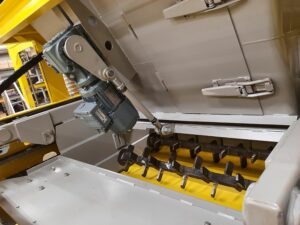
Filling car with rotating shafts and mixing blades
By customer wishes, we can make the filling wagon with shaker rods or without any activators.
The More Complex the Product, the More Repeatability Matters
Simple products may tolerate more process variation than complex ones.
But when the product becomes more demanding with special surface shapes, multi colors or bottom profiles, quality of repeatability becomes much more important.
With one single MEC Block machine, the customer has access to the production of a wide variety of high-quality landscaping and building products in different sizes, shapes, and colors, including the possibility to use alternative raw or recycled materials in mixes and additional items such as automatic EPS insulation feeding system. For multiple dry-cast mixes, the face mix unit with optional equipment and additional software can be included directly from the manufacturing phase, making this more cost-effective than retrofitting later.
In simpler terms: the harder the product is to manufacture consistently, the more important the machine’s repeatability becomes.
This the strongest Mecmetal value proposition: the more complex the manufactured product, the better the advantage the MEC Block Machine brings.
How Recipe Control and Parameter Management Protect Product Quality
Consistent quality is not only about movement. It is also about how easily the process can be adjusted, repeated, and documented.
When product changes can be handled through structured parameters and saved recipes instead of guesswork, the factory becomes less dependent on memory, slower trial-and-error, or operator-specific routines.
In MEC control system easy parameter adjustments and recipe log for different production requirements and product specifications are heart of operation and with MEC Pro Factory as a digital twin that centralizes information from the whole plant. This kind of visibility and traceability matters for quality because it makes the process easier to understand, easier to repeat, and easier to improve over time. When product quality is tied to repeatable settings instead of informal habits, quality becomes more defendable and less vulnerable to variation between shifts or operators.
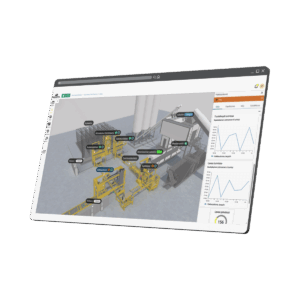
What would you do if you saw everything in your factory in real-time?
Consistent Product Quality in Concrete Block Production Equals Better Business
When product quality is stable, the benefits go beyond the production hall.
The producer gains:
- Less wasted material
- Higher sales
- Higher NPS
- And every person feels confidence in what is being shipped to customers
Builders, landscapers, distributors, and homeowners may never see the machine, but they will notice if the products are easier to install, more visually consistent, and more dependable from batch to batch.
That is why consistent product quality is not just a quality department issue. It is part of brand value and part of commercial credibility. And in competitive markets, that difference matters.
Conclusion
Consistent product quality is not luck. It is the result of repeatable machine movements, stable process control, quality molds, suitable production pallets, correct recipes, and the ability to detect and correct deviations before they become defects.
Mecmetal support a clear quality story: fully electromechanical servo-driven block machines, precise movement on each cycle, real-time quality parameter monitoring, stepless adjustments, strong support for high-quality pavers, blocks and landscaping products, and mold engineering designed for dimensional accuracy and repeatable production.
Ready to reduce variation and improve product consistency?
If block height variation, inconsistent surface quality, rejects, or customer complaints are holding your production back, it may be time to look deeper at the forming phase itself.
Mecmetal’s servo-driven block machine concept, recipe control, and product-specific solutions are designed to help producers improve repeatability, reduce quality-related waste, and deliver more consistent products to the market.
Contact our team to discuss how MEC technology could support your quality targets, production goals and secure next investment.
Part 1: Energy-Efficient Concrete Block Machine
Part 2: Smart Maintenance and Diagnostics
Part 3: Concrete Block Machine Lifecycle Cost
Part 4: You are reading this part.
Part 5: Fault-tolerant desing